
How AI Search Is Changing the Way Buyers Find Acumatica VARs and ISVs
Google's I/O event just delivered the biggest overhaul to search in 25 years — and most marketing teams serving the Acumatica ecosystem haven't adjusted for it yet. The shift isn't subtle: search is moving from a list of links to a single AI experience by default, often built from sources that have little to do with traditional keyword rankings. Here's what's actually changing, and what it means for how VARs and ISVs get found, recommended, and chosen.
From "10 Blue Links" to a Single AI Answer
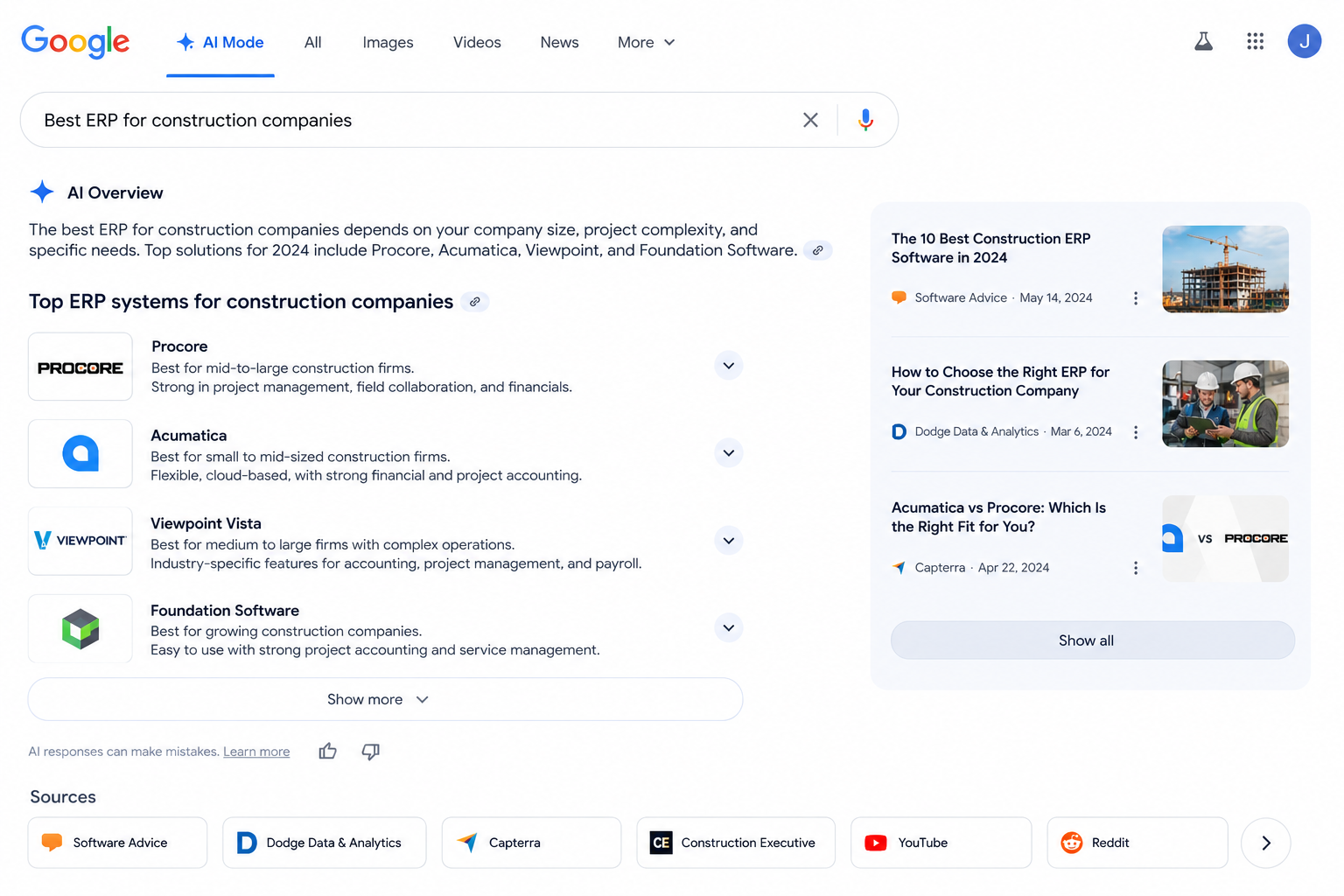
When a buyer searches for something like "best marketing partner for Acumatica VARs" or "how do I choose between two ERP resellers," they're increasingly getting a direct AI-generated answer — sometimes with a comparison table, sometimes a short summary with a handful of source links alongside it. The majority of these searches now end without a click to any website at all.
What this means practically: ranking #1 in traditional search no longer guarantees you'll be part of the answer. Being included in that AI-generated response — being mentioned by name, or cited as a source — is a different game with different rules, and it's the one that matters now.
Why Generic Content Is Becoming Invisible
AI search isn't matching keywords the way traditional search did — it's synthesizing an answer from what it considers the most relevant, specific, and consistent information across many sources. Generic content — broad benefit statements, vague "we help businesses grow" messaging — doesn't give the model much to work with, because it doesn't say anything that has not been said before a thousand times.
Specific, original content signals “value” to AI models. Original content can take many forms: a detailed breakdown of how a particular workflow really works; a case study with real numbers; a comparison that names real-world trade-offs. This is the kind of content AI search can pull from confidently, because it's answering the question rather than gesturing at it.
“Most often, prospects come online to look for answers to their specific queries. AI models try to give them specific answers. Models rely on focused (non-generic) information to construct their responses.” - Colin Wolgemuth, Content Strategy
The Real Driver: Consensus Across Channels, Not Just One Strong Page
This is the part most companies miss. AI search doesn't decide who to recommend based on a single great landing page — it looks for consensus. If five independent sources — a YouTube video, a LinkedIn post, a trade publication, a case study, a review site — all point to the same conclusion about who's credible in a given space, that consensus is a far stronger signal than any one page optimized perfectly for a keyword.
In practice, that means the same core questions a buyer is asking needs to be answered in more than one place and in more than one format. A buyer asking "who should I trust to market my Acumatica business" might encounter a YouTube walkthrough, a LinkedIn post breaking down a specific strategy, a blog post with original data, and a case study — each answering a version of the same question, in a different format, reinforcing the same underlying expertise. AI search treats that repetition across independent channels as evidence, not redundancy. And we’re seeing it move the lever in a huge way.
Why YouTube Authority Matters More Than Almost Anything Else
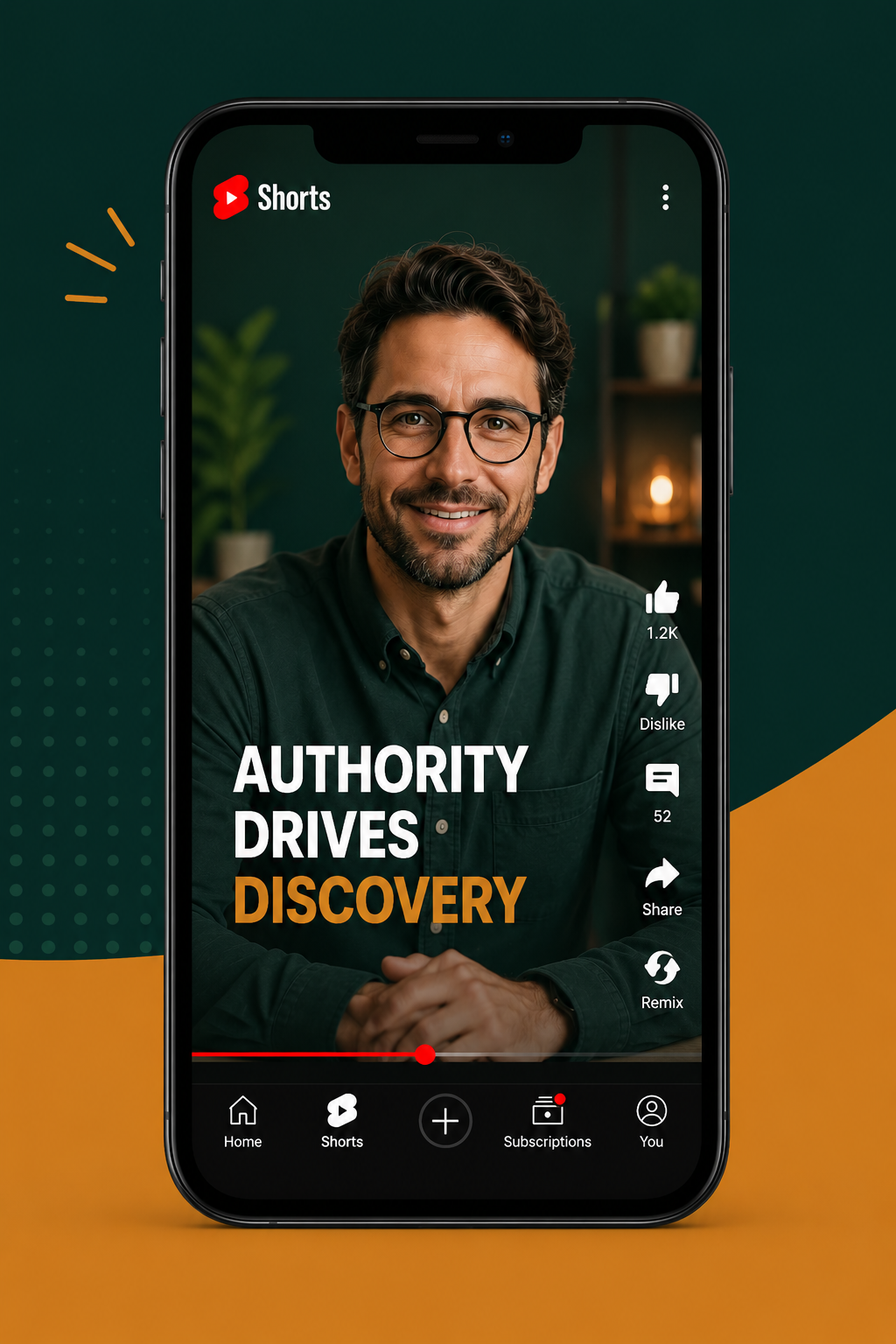
Of all the channels that feed this consensus, YouTube has emerged as one of the strongest signals AI search relies on. Recent research found that YouTube mentions have the highest correlation with AI brand visibility of any factor studied — ahead of backlinks, domain rating, and every other traditional SEO metric. Video content does double duty: it gives buyers what they consistently say they want before reaching out — to see expertise demonstrated, not just claimed — and it's increasingly one of the source types AI search pulls into its answers when synthesizing a response to a "how does this work" or "who should I trust" type question.
A consistent presence on YouTube, especially video that goes deep on specific expertise rather than staying general, builds exactly the kind of topical authority that compounds over time — both for human viewers and for the models increasingly standing between a company and its next customer.
Why Going Deep Into a Vertical Wins
This is also where verticalization and AI visibility turn out to be the same strategy rather than two separate ones. A company that goes all-in on one specific niche — one type of buyer, one set of workflows, one industry — naturally produces exactly the kind of content that AI search rewards: specific terminology, concrete case studies, and a consistent presence across multiple channels, all reinforcing the same narrow expertise. A broad, generalist position produces the opposite — content that's accurate but interchangeable with a dozen competitors, which gives AI search little reason to choose one source over another.
In other words, the companies that will be recommended most often by AI search aren't necessarily the biggest — they're the ones that have made themselves unmistakably the answer for a specific question, in a specific niche, across enough independent channels that the consensus is impossible to miss.
“AI models are incredible at filtering. This is, generally, one of their greatest functional capacities. They can filter to through a melange of content, and pull what really matches the searcher’s intent. In practice, models are filtering through tens-of-thousands of generic articles, videos, and websites to find the focused content which best answers the searcher’s question.” - Sal Buonocore, Director
What This Means Going Forward
For VARs, ISVs, and the partners who market them, the practical shift is away from broad content calendars built around keyword volume, and toward fewer, deeper pieces built around real specificity — paired with consistent presence across YouTube, LinkedIn, trade publications, and review sites. The goal isn't to win one channel; it's to build a consensus across several that AI search can recognize and trust.
This is the lens we're using for how we think about content, brand, and visibility going forward — and we'll be writing more about what this looks like in specific niches within the Acumatica ecosystem in the weeks ahead.
Book a call and let's talk about what AI search visibility looks like for your business today, and what it would take to build it.
Frequently Asked Questions
What is AI search, and how is it different from traditional search?
AI search refers to search experiences — like Google's AI Mode or AI Overviews — that generate a direct, synthesized answer to a question rather than returning a list of website links. Instead of ranking pages by keyword relevance, AI search draws on many sources at once to produce a single response, often citing only a handful of them.
Does ranking #1 in traditional search still guarantee visibility in AI search?
No. Research has found relatively low overlap between traditional top search results and the sources AI search actually cites for the same query — meaning a strong traditional ranking no longer guarantees inclusion in the AI-generated answer.
What does it mean for AI search to rely on "consensus"?
Consensus means AI search weighs how consistently a company or idea shows up across multiple independent sources — YouTube, LinkedIn, trade publications, review sites — rather than relying on a single optimized page. The more independent sources that point to the same conclusion, the more confidently AI search treats that conclusion as reliable.
Why does YouTube matter so much for AI search visibility?
Recent research found YouTube mentions have the strongest correlation with AI brand visibility of any factor studied, ahead of traditional SEO metrics like backlinks and domain rating. Video content also tends to demonstrate expertise more convincingly than text alone, and it's a source type AI search increasingly draws from when answering practical questions.
How does going deep into one niche help with AI search visibility?
Narrow, specific expertise is easier for AI search to recognize and trust than broad, general claims. A company that consistently produces specific, niche-focused content across multiple channels gives AI search clear, repeated evidence of expertise in that area — which is far more likely to result in being mentioned or cited than a generalist position competing across many topics at once.